

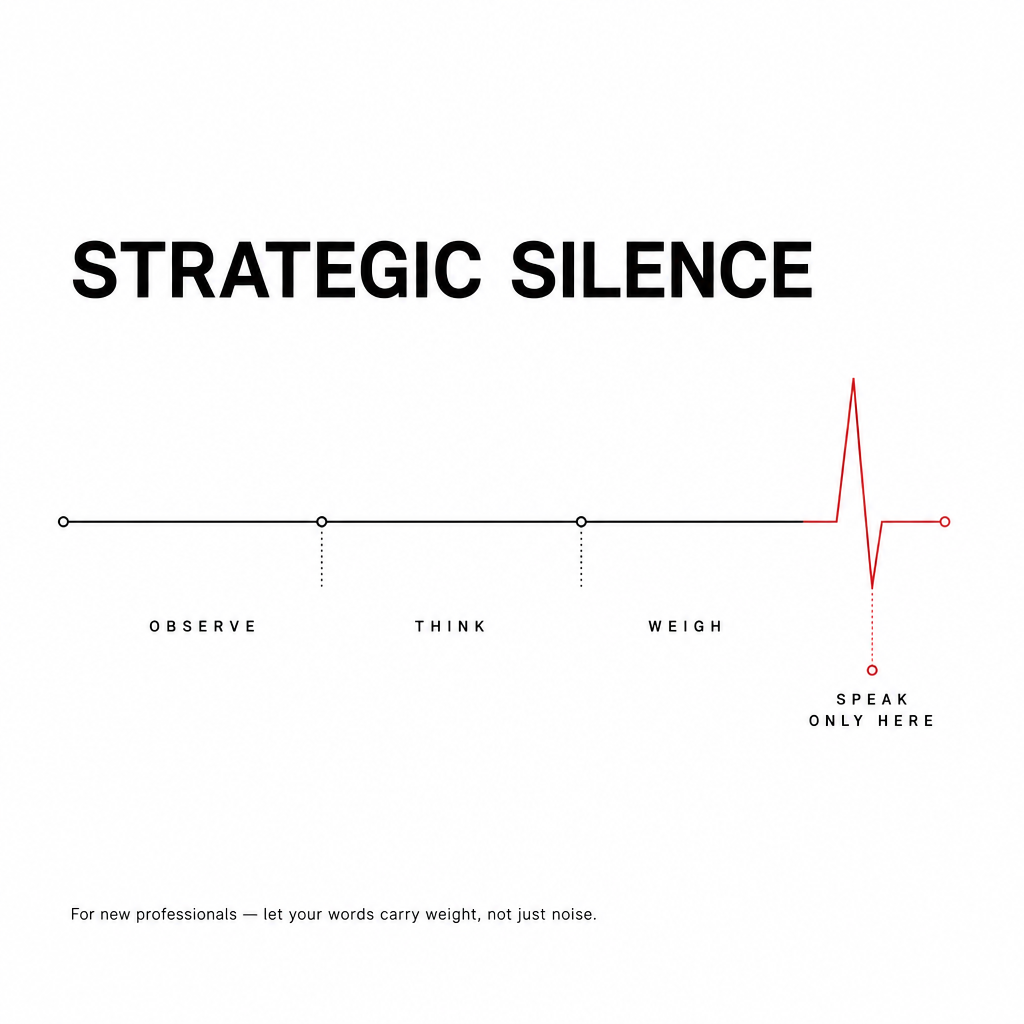
You walk into your first team meeting, heart beating a little faster than it should. You have prepared a handful of clever points, eager to prove you belong. The senior manager asks a question. A junior colleague jumps in immediately, filling the air with words that sound impressive but add little. You feel the pressure to speak, to show you are engaged and intelligent. So, you do. You string together a thought that, in hindsight, felt half-formed. The room nods politely and moves on. Later, you realise the real insight only came to you ten minutes after the meeting ended. If you had just waited, let the silence stretch, you could have offered something truly valuable.
This is not a call to become a wallflower. It is an invitation to understand that, for a school leaver, a graduate, or a junior staff member, silence is not the absence of power. It is a strategic tool, sharpened by intention. In a world that rewards the loudest voice in the room, learning when to hold back can be the single most career-defining skill you develop early on, and, increasingly, this is not just folk wisdom. It is a claim that organizational psychologists and negotiation researchers have spent the last decade quietly and rigorously testing.
The Currency of the Workplace Is Not Airtime
At the start of your professional life, there is a powerful and often misguided pressure to be visible. You have been conditioned by classrooms and seminar halls where participation marks are earned by raising your hand quickly. The workplace, however, operates on a different currency. Your value is not measured by how often you speak, but by the weight your words carry when you finally do. A person who talks constantly creates a low signal-to-noise ratio. Colleagues learn to tune them out, a survival mechanism in noisy open-plan offices. Conversely, a junior team member who listens intently and then offers one precise, well-timed observation immediately stands out. The silence before that comment was not emptiness; it was the sound of someone thinking, synthesising, and respecting the conversation enough to add only what matters.
This intuition now has real empirical backing. Research on leadership style conducted by Wharton’s Adam Grant with Francesca Gino and David Hofmann examined a national pizza-store chain and found a striking pattern: stores run by extraverted managers earned notably higher profits when staff were passive and simply followed instructions, but stores run by more introverted, quieter managers outperformed them when staff were proactive and full of their own ideas. A follow-up lab study using student teams replicated the same reversal. The explanation the researchers offered was straightforward: extraverted leaders tend to enjoy being the centre of attention and can feel undercut by employees who propose their own ideas, while quieter leaders are more inclined to listen carefully and actually implement what they hear. The lesson generalises down the hierarchy too: in any environment where good ideas are meant to travel upward, the person who talks the least sometimes does the most to make that possible, simply by creating room for others to think out loud.
Silence as a Tool for Reading the Room
Strategic silence is also your greatest tool for observation. As a new entrant, you are stepping into a pre-existing ecosystem of relationships, unspoken rules, and power dynamics that no induction manual can map. Who truly holds influence, despite their job title? Who is perpetually dismissed, and why? Which topics make the room tense up? If you are speaking, you are not absorbing these vital data points. Choosing silence allows you to read the room with the clarity of an anthropologist. You start to hear what is said between the lines: the slight hesitation before an answer, the overly quick agreement that signals fear, the gentle redirection that reveals the real decision-maker. This intelligence is free and abundant, but only if you are quiet enough to collect it.
What the Negotiation Research Actually Shows
There is also a profound dignity in refusing to fill every pause, and this is where the strongest evidence for strategic silence comes from. A 2021 study led by MIT Sloan professor Jared Curhan, working with colleagues from Melbourne Business School, the University of La Verne, Penn State Harrisburg, and ShanghaiTech University, recorded real negotiation sessions and used a computer algorithm to flag every pause lasting three seconds or longer. Across several experiments, some observing naturally occurring pauses, others instructing one side to deliberately insert silence, the pattern held: extended silences reliably preceded breakthroughs in the negotiation, and the parties who used silence tended to report better joint outcomes, not just better outcomes for themselves.
The mechanism the researchers identified matters more than the headline finding. Negotiators who paused shifted out of a reactive, zero-sum mindset and into what the team called a more deliberative state, one in which they stopped assuming the other side’s gain must be their loss, and instead started noticing options that expanded the whole deal for both parties. Crucially, the research also found that using silence this way did not make the other party view the silent negotiator less favourably; it did not read as weakness, hesitation, or a stalling tactic. It read as thoughtfulness.
This lines up with older, more practical guidance from Harvard Law School’s Program on Negotiation, which has long taught that when a counterpart opens with an aggressive or unreasonable figure, a calm, unhurried silence does more to puncture that anchor than any amount of vocal protest, particularly over the phone, where the other side is left to sit with the discomfort of not knowing what your quiet means. Early career professionals often mistake silence for awkwardness, a gap they are personally responsible for bridging. They rush in with filler words, nervous laughter, or a repetition of what was just said. This habit can make you appear junior far more than your actual age or title does. Training yourself to be comfortable with a pause signals quiet confidence. When you ask a question and the other person thinks before answering, let them. Do not dilute the moment by rephrasing the question or suggesting an answer. That silence is theirs, and respecting it communicates that you are a patient, serious professional. In negotiations, even small ones about deadlines or resources, the person who can comfortably hold silence often holds the power. The other party feels a subtle, almost biological need to fill the void, and in doing so, they often reveal more than they intended or make a concession you did not even have to ask for.
It’s worth noting one important caveat the MIT researchers flagged themselves: comfort with silence is culturally variable. Their subjects were mostly English-speaking negotiators, among whom the average conversational pause runs only one or two seconds. In many East Asian business contexts, by contrast, long silences are the ordinary rhythm of a serious discussion rather than a tactic at all, one frequently cited account describes a Japanese negotiating team sitting silently for a full twenty minutes before ultimately accepting an American counterpart’s terms. The takeaway for a graduate anywhere is not “always be silent for a fixed number of seconds,” but rather: notice what silence signals in the room you are actually in, and use it deliberately rather than filling it out of nervous habit.
When Organizational Silence Turns Dangerous: The Case for Speaking Up
This approach must never be confused with passivity or a lack of ideas, and there is a sobering body of research showing exactly what happens when silence stops being strategic and becomes structural. NYU Stern professor Elizabeth Wolfe Morrison, whose decades of research on what she calls “employee voice and silence” is among the most cited work in organizational psychology, has documented how withholding information from someone in a higher position, even when an employee has genuinely useful concerns, deprives an organization of exactly the input it needs to catch problems early. Morrison and her colleague Frances Milliken described how, in some workplace cultures, employees quietly conclude that speaking up will change nothing or will actively damage their standing, and so they say nothing even when they can see a problem forming.
The most frequently cited real-world illustration of this dynamic is NASA’s Space Shuttle Columbia disaster in 2003. In the organizational behaviour literature, the Columbia case is treated as a textbook example of silence functioning as a barrier to learning rather than a source of insight: engineers had concerns about damage to the shuttle’s wing during launch, but the internal culture made it difficult for those concerns to travel up through the hierarchy with the urgency they deserved. Researchers studying organizational silence point to Columbia, alongside the collapse of Enron in 2001, as cases where a pattern of employees not voicing what they knew contributed to catastrophic outcomes. The point for a junior professional is not to be intimidated out of ever saying anything, but to recognise the difference between silence used to observe and refine a contribution, and silence used to avoid a difficult conversation that genuinely needs to happen.
Cornell’s James Detert and Harvard’s Amy Edmondson have added an important layer to this picture with their research on what they term “implicit voice theories”, largely unspoken, self-imposed rules that employees carry about when it is and is not safe to speak up, such as believing that only people with strong data or seniority have standing to raise a concern. Their work suggests many of these self-censoring beliefs are learned early in a career and rarely tested, meaning a graduate who assumes silence is always the safer, more mature choice may simply be running an unexamined rule rather than making a genuine judgment call. The distinction lies in intent. Destructive silence is born from fear; you stay quiet because you are terrified of looking stupid, or because an implicit rule has told you it isn’t your place to speak. Strategic silence is born from discipline; you stay quiet because the moment is not yet right, or because your word has not yet been earned.
To apply this, you must prepare. Before a meeting, instead of scripting the first thing you will say, write down one powerful question you want to ask. Then spend the entire meeting listening for the precise moment that the question will land with maximum force. You might wait forty minutes. You might discover the meeting naturally answers it, in which case you were wise not to speak prematurely, and you leave with your reputation intact. The discipline is in resisting the adrenaline-fuelled urge to speak just to relieve your own anxiety, and in staying alert enough to recognise the moment when your silence has stopped being strategic and has quietly slid into the kind of self-censorship Detert and Edmondson describe.
Silence as a Shield Under Pressure
Silence is also your shield. In moments of conflict, criticism, or high stress, the instinct to react defensively is overwhelming. A sharp email arrives, loaded with unfair accusations. Your face flushes, your fingers hover over the keyboard to fire back an immediate, point-by-point rebuttal. This is the moment strategic silence becomes a superpower. A reactive response, sent in a state of emotional hijack, can brand you as difficult, immature, or hot-headed for years. Instead, step away. Let the unread message sit. Let your brain’s rational circuits catch up with its emotional ones. This is essentially the same mechanism Curhan’s negotiation research points to: a pause interrupts the reflexive, defensive mode of thinking and creates room for a more deliberate one. Often, what feels like an emergency at 10 a.m. feels like a simple misunderstanding by 3 p.m. The reply you craft after a strategic pause will be measured, professional, and unassailable. You have chosen a response rather than a reaction, and that gap in time was your sanctuary.
Asking for Help Without Undermining Yourself
For graduates and school leavers, there is a unique application of silence in the art of asking for help. You are expected not to know things. Your greatest professional risk is not ignorance, but pretending to know and getting it wrong. When a senior colleague is explaining a complex process, fight the urge to nod along with a false look of comprehension. Instead, be silent, concentrate, and when they pause, say: “I want to make sure I truly grasp this, could you walk me through the second step once more?” This admission, framed not as confusion but as a commitment to precision, earns immense respect. Your silence during the explanation was a sign of deep processing, not drifting off. You transform a potential weakness into a display of diligence simply by being mindful of when to listen and when to clarify.
The Social Case for Listening
Socially, the same principle builds a magnetic professional presence. People gravitate toward those who make them feel heard. Early in your career, networking can feel like a performance where you must sell yourself. Try the opposite. At the next industry event, ask someone about their journey and then truly, silently listen to the answer. Do not interrupt with your own similar story. Do not scan the room over their shoulder. Just listen, letting their words land. When they finish, acknowledge what they said with a thoughtful follow-up question. You will be remembered as a fantastic conversationalist, despite having barely spoken about yourself. This is the paradox of strategic silence: it says more about your character than a hundred self-promoting anecdotes ever could.
Calibrating Silence to Your Environment
However, mastering this tool requires situational awareness; strategic silence is not a one-size-fits-all mandate, and you must calibrate your approach to your specific environment. In some highly aggressive, extroverted corporate cultures, certain fast-paced startups or sales-driven firms, for instance, prolonged silence might be misread as disengagement or a lack of ideas. Conversely, in certain high-context global cultures, silence is already the baseline of respect, meaning your strategy should focus less on the mere act of withholding speech and more on the precise timing and weight of your eventual input. As the Japan example above suggests, the same twenty minutes of quiet that would alarm a Western sales floor is, in another business culture, simply the sound of a deal being taken seriously.
The Equity Problem Silence Doesn’t Solve on Its Own
Furthermore, it is vital to recognize that the luxury of pure silence is not universally distributed. Morrison’s review of the employee voice literature notes a finding that should give any junior professional pause: some of the earliest studies in this field found that employees who were rated by peers as speaking up more actually saw better long-term promotion and salary outcomes, not worse, which suggests that in many organizations, silence alone, however elegant, is not sufficient to be recognized. For women, minorities, or individuals from marginalized groups in the workplace specifically, simply staying quiet can sometimes inadvertently reinforce existing biases that render them invisible rather than impressive. In these contexts, strategic silence must be actively paired with strategic visibility. If you choose to absorb information silently in a meeting, ensure you amplify your impact afterward. Follow up with a brilliantly synthesised email, share a crucial data point in a team chat, or pull a stakeholder aside. This ensures your quiet observation translates into undeniable, documented value, preventing your silence from being mistaken for absence.
Making It a Practice
Choosing silence strategically is a practice, not a personality type. It is a deliberate decision you make multiple times a day in small, ordinary moments. Tomorrow, in your first meeting, see what happens when you speak only once, but make it the insight that ties two conflicting points together. In a conversation with a frustrated customer or stakeholder, try pausing for three full seconds after they finish venting before you offer a solution, the same three-second threshold Curhan’s team used to identify the pauses that preceded real breakthroughs. You will discover that those three seconds drain the immediate tension from the air and make your voice sound like the voice of reason.
This is not about muting your ambition; it is about amplifying your impact by ensuring that when your voice enters the room, the room has a reason to lean in. The research is now reasonably consistent on this point, whether it comes from a negotiation lab at MIT, a pizza chain studied by Wharton, or the sobering case files of organizations that failed to listen to their own engineers. In a culture that has confused noise with productivity, your quiet, measured confidence will feel like a revelation. It will whisper what you want to prove: that you are not here to fill the silence, but to use it, masterfully, to build something that lasts.
References
Curhan, J. R., Overbeck, J. R., Cho, Y., Zhang, T., & Yang, Y. (2022). Silence is golden: Extended silence, deliberative mindset, and value creation in negotiation. Journal of Applied Psychology, 107(1), 78–94. https://doi.org/10.1037/apl0000877
(Note: Originally circulated as an MIT Sloan working paper in 2020/2021 prior to its 2022 peer-reviewed publication.)
Detert, J. R., & Edmondson, A. C. (2011). Implicit voice theories: Taken-for-granted rules of self-censorship at work. Academy of Management Journal, 54(3), 461–488. https://doi.org/10.5465/amj.2011.61967925
Grant, A. M., Gino, F., & Hofmann, D. A. (2011). Reversing the extraverted leadership advantage: The role of employee proactivity. Academy of Management Journal, 54(3), 528–550. https://doi.org/10.5465/amj.2011.61968043
Milliken, F. J., & Morrison, E. W. (2000). Organizational silence: A barrier to change and development in a pluralistic world. Academy of Management Review, 25(4), 706–725. https://doi.org/10.5465/amr.2000.3707722
Morrison, E. W. (2014). Employee voice and silence. Annual Review of Organizational Psychology and Organizational Behavior, 1(1), 173–197. https://doi.org/10.1146/annurev-orgpsych-031413-091328
Morrison, E. W. (2023). Employee voice and silence: Taking stock a decade later. Annual Review of Organizational Psychology and Organizational Behavior, 10(1), 79–107. https://doi.org/10.1146/annurev-orgpsych-120920-054654
Program on Negotiation at Harvard Law School. (n.d.). Silence in negotiation: Why saying nothing can be powerful. https://www.pon.harvard.edu/daily/negotiation-skills-daily/dear-negotiation-coach-when-silence-is-golden-nb/