
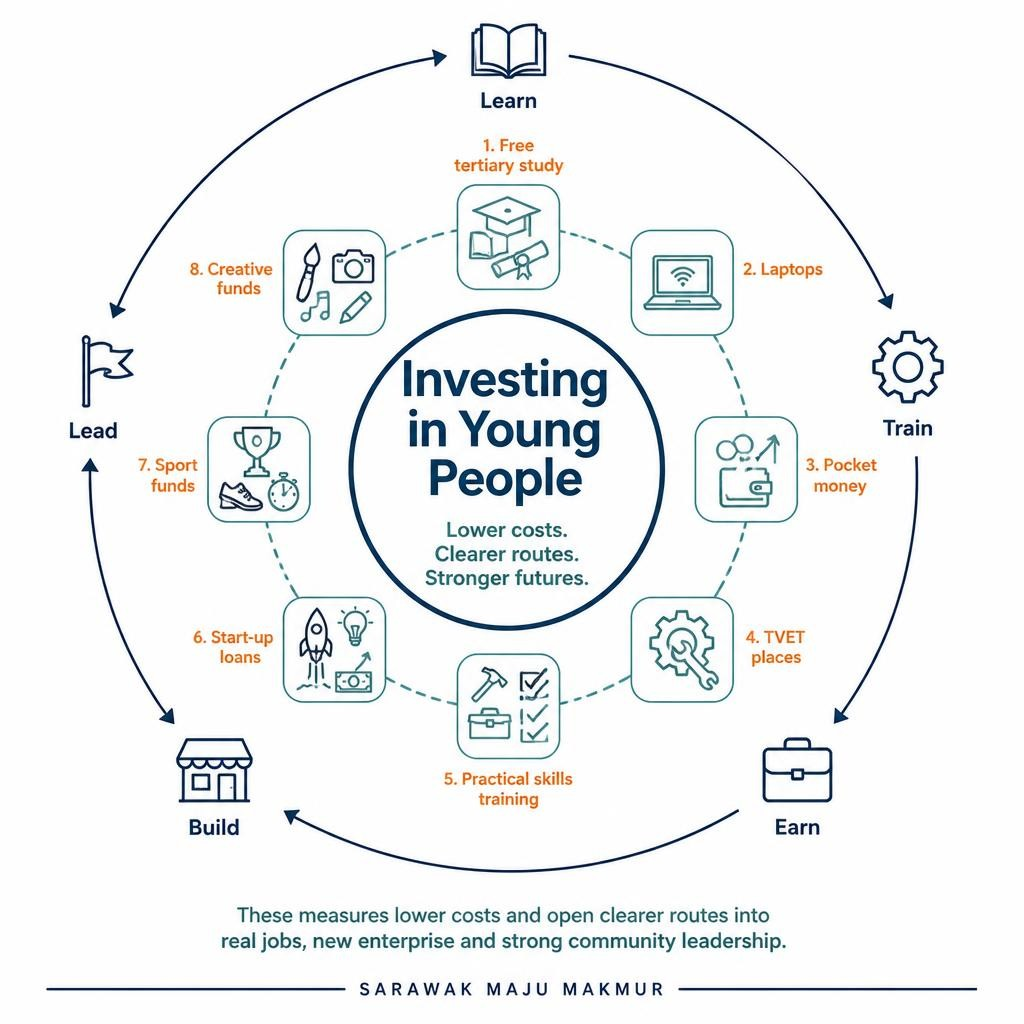
- Free tertiary study, laptops and pocket money reduce costs for eligible Sarawak students.
- TVET and industry training open practical routes into technical, digital and aerospace jobs.
- Scholarships, flight subsidies and book vouchers help learners stay in study and travel home.
- GETS placements and start-up loans support graduates moving into work or business.
- Youth funds, sport events and creative grants build experience, networks and confidence.
Sarawak Budget 2027 allocates RM454.34 million to education and talent development, with additional funding for youth, sports and skills. The message is simple: invest in people early, keep them learning, and give them strong reasons to build their future at home. The sections below set out what each allocation offers young Sarawakians, how it aligns with state and federal plans, and where it can be strengthened.
Starting early and staying in school
SeDidik receives RM29 million, a RM14 million special grant supports all registered early childhood centres, and RM4 million subsidises TADIKA and TASKA fees for households earning RM7,000 a month or less. For young parents, this means affordable childcare and a better start for their children.
RM200 uniform vouchers (RM4 million) and the Free School Bus Programme in Kuching, Sibu, Bintulu and Miri (RM10 million) lower the cost of simply getting to school.
English, Science and Mathematics open doors to technical and digital careers, so the Dual Language Programme (RM1 million) and the Year 6 UP-DLPS test (RM6 million, reviewed by Cambridge University Press & Assessment) show pupils where they stand. SEEP tuition support (RM25 million) offers free classes to about 113,000 students in 186 secondary schools before SPM, the key to diplomas, TVET and matriculation.
The Yayasan Sarawak International Secondary School (RM40 million for operations, RM38 million for new campuses in Bintulu and Miri) brings another school option closer to families there. School upgrading, backed by RM1 billion (RM700 million already advanced by the state against federal loans) and RM29 million for SMK Gedong, SK Sageng, SJK(C) Tong Ah and SK Tupong, gives students safer places to learn.
University and graduate years
The Free Tertiary Education Scheme (RM200 million) covers up to 10,600 students in 64-degree programmes at four Sarawak-owned universities, so a place depends on merit, not family income.
Around it sit free laptops for first-year diploma and degree students (RM30.5 million), book vouchers (RM2 million), special pocket money (RM50 million), a PTPTN repayment subsidy for borrowers who have repaid more than 30% (RM10 million), i-GPS flight subsidies of up to RM300 per trip, twice a year (RM8 million), and scholarships (RM18.5 million from the state and RM206 million through Yayasan Sarawak). Together they cover tuition, tools, daily costs, debt and the journey home.
A constructive point: free tuition applies only at Sarawak-owned universities, so students elsewhere rely on the other aids. Clear guidance on who qualifies for what would help them. Publishing graduation and job results for each programme would also keep the 64 programmes matched to real demand.
Skills and jobs
The TVET network of Sarawak Skills, i-CATS University College, CENTEX campuses and Kolej Laila Taib receives RM121.5 million for operations and RM13 million for development, including the Advanced Automotive Training Centre and the SAVTI campus upgrade. NextGen TVET adds RM4.5 million, bringing the total to about RM139 million.
This gives school leavers a practical route into work. At the high end, RM8.5 million for semiconductor talent offers certifications through partners such as Melexis, Synopsys and Siemens. In aerospace, RM42 million starts the i-CATS main campus at Trombol, CENTEXS runs an aerospace academy with partners including Angkasa-X, SDEC and Tsinghua University, and RM1.5 million funds a masterplan. The Sarawak Artificial Intelligence Centre (RM5 million) gives young people practical AI exposure, and the Digital Economy Blueprint 2030 aims for 50,000 digital jobs.
For graduates, 61% of GETS participants were employed by July 2026. RM22 million will support 1,000 graduates with a RM1,500 monthly allowance, workplace training and industry certificates. A further RM13.6 million backs programmes such as Graduan Ke Arah Keusahawanan, Go Digital, Satu Daerah Satu Industri and the Sarawak Global Export Programme, alongside training, capital and market access for single mothers, persons with disabilities and vulnerable families.
Young civil servants gain from the RM25 million Leadership Institute and from MICPA and CIA qualifications through the Sarawak Centre of Performance Excellence.
Here the main challenge is scale. GETS places 1,000 graduates, while FTES alone may bring up to 10,600 students into degrees. Growing placements and reporting what happens to the 39% who did not find work would turn a good programme into a pipeline.
Enterprise, culture and sport
TEGAS (RM12.5 million) offers the Digital Village Innovation Hub, an entrepreneurship programme and TEGAS Lodge. The Young Entrepreneur Soft Loan Facility (RM25 million through Affin Bank), youth programmes such as Belia GO-BIS, SEED and Youth Entrepreneur Setup 3.0 (RM1.2 million) and SYstartUP (RM3 million, covering e-invoicing, halal certification, intellectual property and AI) give young founders capital and know-how.
The Youth Creative Industry Fund (RM500,000) supports artists and creators. SSEAYP 2027 (RM3 million), the Sarawak, Johor, Sabah and Melaka Youth Integration Programme (RM250,000) and the flagship youth event (RM1 million) widen networks, and the Youth Index Study (RM1 million) will show what young people need.
The SEA Games bring RM120 million for organisation and RM144 million for 11 facilities, with about 4,000 volunteers expected. SUKSAR (RM5 million), Sarawak X-Tive (RM1.2 million, 120,000 participants) and RM21 million for local facilities give athletes and volunteers room to grow. To leave a lasting legacy, volunteers could receive recognised certificates in event management and sports support.
Fit with PCDS 2030 and state policy
PCDS 2030 treats education and human capital as a fundamental pillar, aiming for a skilled workforce and equitable access to quality education. Free tertiary education was planned for 2026 as part of revamping the education system. In 2024, the education minister said Sarawak realistically aims for 30 to 40 per cent high-skilled workers by 2030.
The budget delivers on this: FTES and pocket money widen access, TVET and industry programmes build skills, and the new Sarawak Education Council will align schools, STEM, teacher training and universities with strategic industries. The labour market can absorb them, with Sarawak’s overall unemployment rate at 3.1% in the third quarter of 2025 (DOSM), a figure the state youth ministry applies to its 15 to 40 youth definition.
Fit with RMK13 and Federal Budget 2027
The 13th Malaysia Plan targets 700,000 new manufacturing jobs and 500,000 digital economy jobs by 2030, supported by the Perkasa Madani TVET Financing Scheme and the TVET Training Fund to encourage youth participation.
Federal Budget 2027 backs this with RM8 billion for TVET across ministries, RM3 billion for HRD Corp (offering three million training opportunities), and a target of 30,000 new job opportunities through Bakat Madani.
It gives nearly RM69 billion to the Education Ministry and RM16.2 billion to Sarawak, and doubles Public Service Department (JPA) scholarships for Sabah and Sarawak students, to 4,200 a year. Back-to-school aid rises from RM150 to RM200 per pupil for 5.3 million pupils.
PTPTN repayments are deferred for borrowers earning up to RM2,500, and FlySiswa rises from RM400 to RM500. In August 2026, national youth unemployment was 10.1% for ages 15 to 24 and 6.3% for ages 15 to 30, against 2.9% overall, which shows why linking skills to jobs matters. Sarawak’s schemes complement these federal measures rather than duplicate them, and its semiconductor, aerospace and digital programmes feed directly into national goals.
Making a good plan stronger
Three steps would help. First, track results such as employment, income and graduate retention, not only spending. Second, reach rural youth: with settlement-area internet coverage heading to 94.5%, outreach in longhouses and small towns should explain every scheme in plain language. Third, coordinate with federal programmes so Sarawak youth also claim Bakat Madani and HRD Corp places, and so state and federal aid leave no gaps.
Overall, the budget is generous, coherent and well aligned with state and national plans. Its next test is turning funding into jobs and enterprises for young Sarawakians.
References
Department of Statistics Malaysia. (2025, November 10). Principal statistics of labour force, Malaysia, third quarter 2025. https://www.dosm.gov.my
Department of Statistics Malaysia. (2026, October 9). Labour force statistics, August 2026. https://www.dosm.gov.my
Prime Minister’s Office of Malaysia. (2026, October 9). Speech: The Fifth Madani Budget 2027 by YAB PM. https://www.pmo.gov.my/en/speeches-en/speech-the-fifth-madani-budget-2027-by-yab-pm/
Sarawak State Legislative Assembly. (2026, October 12). Penyata rasmi persidangan Dewan Undangan Negeri Sarawak: Mesyuarat kedua bagi penggal kelima, Dewan Undangan Negeri Sarawak kesembilan belas [Official report of the Sarawak State Legislative Assembly debate]. https://duns.sarawak.gov.my/web/attachment/show/?docid=dklYbitJM1FuWGY1bndHWXBQalB3UT09OjrO6oFClr0B3F1U1F7NIy3h
The Malaysian Reserve. (2025, July 31). 13MP: 1.2m new jobs in manufacturing and digital sectors, 10% cap on foreign workers by 2030. https://themalaysianreserve.com/2025/07/31/13mp-1-2m-new-jobs-in-manufacturing-and-digital-sectors-10-cap-on-foreign-workers-by-2030/
Unit Komunikasi dan Penerangan Sarawak (UKAS). (2025, November 5). Human capital, key to driving PCDS 2030. https://ukas.sarawak.gov.my/web/subpage/news_view/27882