
You wake up, put on your school uniform or work shirt, and step out the door. You smile, you nod, you say you are fine.
But underneath, there is a weight. Maybe it is the pressure to get perfect grades. Maybe it is the fear of letting your family down. Maybe it is the loneliness of feeling like nobody really sees you.
In Sarawak today, so many of us are carrying that same invisible load, and it is time we talked about it openly, without shame, and without masks.
The numbers are real, and they tell our story.
Mental health struggles affect 35.8 per cent of people in our state, with the heaviest burden falling on rural Bumiputera communities.
Across Malaysia, the national helpline Talian HEAL 15555 received close to 91,000 calls in 2025 alone, double the year before.
Most of those callers were between 18 and 35 years old, young people just like you and me.
Suicide deaths in Sarawak rose from 40 cases in 2020 to 63 in 2024, and nearly 80 per cent of those lost were men, many of them young adults trying to hold everything together.
Even among adolescents, one in four has battled depression and one in ten has attempted suicide.
These are not just statistics.
They are brothers, sisters, classmates, and friends.
They are people who felt they could not speak up.
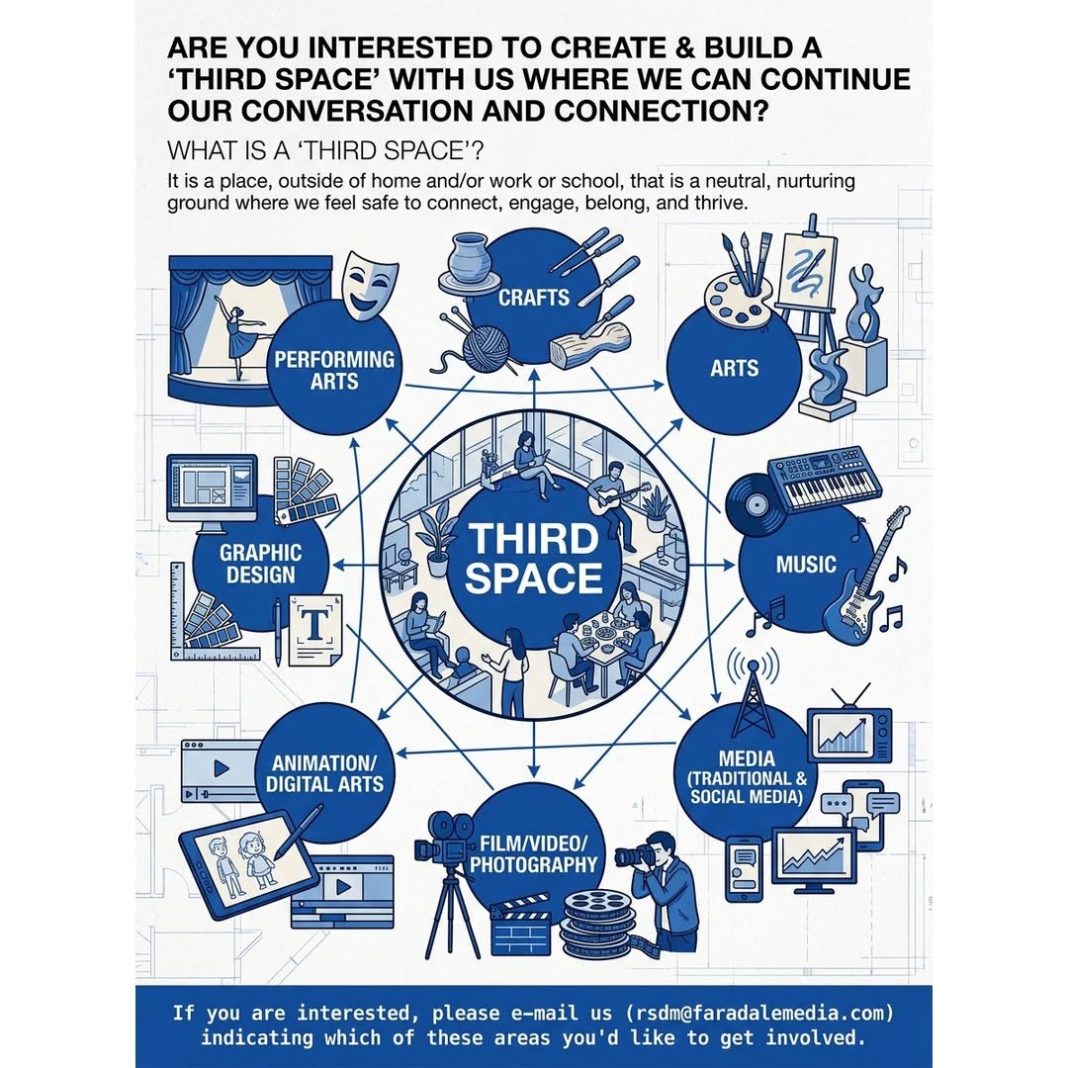
But what if there was a place where you could take off the mask and just be yourself without judgment? A place where status does not matter, where conversations heal, and where you can learn to care for your own mind while supporting others? That place exists, and it is called a Third Space.
You might have heard the term before, but let me break it down simply.
A sociologist named Ray Oldenburg studied the places where communities truly come alive.
He found they share eight essential ingredients.
First, they are neutral ground, meaning you can come and go freely without the pressures of being a host or a guest.
Second, they are levellers; outside status means nothing, so a student and a psychiatrist can sit together as equals.
Third, conversation is the main activity, playful and honest talk that builds real bonds.
Fourth, they are accessible and accommodating, easy to reach with flexible hours that fit your life.
Fifth, regulars anchor the space, creating a familiar rhythm that makes it easier for newcomers to join.
Sixth, they keep a low profile, homey and unpretentious, where comfort matters more than style.
Seventh, the mood is playful, full of wit and warmth, keeping hostility out.
And eighth, they feel like a home away from home, grounding you in security and belonging.
In a diverse society like ours, there is an extra layer.
Scholar Homi Bhabha described a Third Space as a zone where cultures mix and new understanding grows beyond ethnic labels or social roles.
For young Ibans, Chinese, Melanau, Bidayuh, and all the ethnicities of Sarawak, this means we can rewrite the stories that separate us by sharing our vulnerabilities together.
The RAKAN Sarawak Destiny Movers (RSDM) program, supported by Faradale Media-M, has brought this vision to life right here in Bintulu and now expanding to Miri.
Their 2026 workshop “Unmask the Mind to Thrive and Flourish” is not your typical mental health talk.
It is a living Third Space.
When you walk in, you leave behind the label of “good student” or “obedient child.” You are not a patient or a diagnosis.
You are a human being ready to explore your emotions, reconnect with your authentic self, and discover that vulnerability is actually a strength.
At the Bintulu workshop, the space was deliberately set as neutral ground away from school hierarchies and home expectations.
A psychiatrist from Hospital Bintulu, a facilitator, and a teenager could sit in the same circle and share insights on depression and stigma as co-learners.
The main activities were conversation and creative expression, using sessions like “Language Matters” to make empathetic dialogue a tool for healing.
The atmosphere stayed playful and low profile through the “HeART Space” and reflective discussions around the film “Azimat,” where art, storytelling, and humour created the easy warmth of a home away from home.
Over 90 participants from secondary schools, technical institutions, and public universities took part, and the content spoke directly to their daily realities.
What happens in these spaces is transformative.
Resilience is not built by lectures on toughness but through social support and shared experience.
Authenticity emerges because the environment signals it is safe to set the mask aside.
Kindness is structured into the program through a “Building a Safety Net” component.
Advocacy is seeded as you learn to recognize early signs of emotional distress in friends and offer initial support.
Nurturing becomes a method, not just a nice idea, as you practice grounding techniques, box breathing, and the ALEC model of emotional awareness.
The results speak for themselves.
After the workshop, more than 90 per cent of participants felt stronger confidence, gained practical coping strategies, and were motivated to build psychologically safe environments around them.
Many reported they could now better spot early signs of distress and provide first-step support before professional help is needed.
You become an everyday first responder for mental well-being in your family, your peer group, and your neighbourhood.
Because of this success, the program is growing.
The HOPE workshop in Miri (Healing, Outreach, Prevention and Empowerment) now extends this work, and new modules on workplace neurodiversity, digital hygiene, and rural mental health are being developed.
Local partners like Lembaga Pelabuhan Bintulu and BIG Pharmacy back these efforts through corporate social responsibility, but the heart of the movement is young people choosing to show up.
You might wonder why this matters on a larger scale.
Sarawak’s Post Covid-19 Development Strategy 2030 (PCDS 2030) aims to double our economy and ensure social well-being for every citizen.
The Premier has stressed that inclusive development must reach all communities, and that unity in our diversity is the cornerstone of progress.
National policies like the National Social Policy 2030 and the National Strategic Plan for Mental Health 2020-2025 all push for preventive, community-based mental health care.
Budget 2026 introduced the K-MindSET program to boost mental health literacy and community support networks.
And globally, the Sustainable Development Goals (SDG 3 and 10) link mental health to good health and reduced inequalities.
Third Spaces like RSDM are where these policies become real conversations and real lifelines.
But policy papers will not save a life; a friend who knows how to listen might.
That is why your role is vital.
The research from around the world confirms what we are seeing locally.
In rural Australia, a simple men’s walking group became a Third Place that lifted mood, built belonging, and supported men through tough times without any building or big budget.
In Canada, a youth mental health program using Third Space principles not only improved personal well-being but turned participants into advocates for policy change in their communities.
In the United States, arts-based Third Spaces helped Black women redefine resilience as rest, joy, and refusal of systemic pressure, transforming their self-perception.
Even during the pandemic, virtual third spaces like online game sessions and crafting circles broke down social barriers and fostered agency among isolated students.
These examples prove that healing does not always require a hospital.
Often it requires a circle of people walking and talking on neutral ground, a room where you can unmask your mind without judgment, a space where art gives shape to pain that words cannot carry.
So, what can you do? First, actively seek information.
Knowledge is the first step to breaking stigma.
Follow the RSDM initiatives and learn about workshops near you.
Check out platforms like iSarawakCare, an online portal that connects you to healthcare, education, and community support services.
The Sarawak government and Ministry of Women, Family and Community Development also run psychosocial programs, mobile counselling units, and parenting initiatives.
Do not wait until you or someone you love is in crisis.
Familiarize yourself with the ALEC model, box breathing, and grounding techniques.
They are simple, powerful tools you can carry anywhere.
Second, support and join Third Space initiatives.
If there is an RSDM workshop or HOPE event in your area, sign up.
If you have already attended one, become a regular who anchors the space for others, helping newcomers feel safe.
If you are an artist, a storyteller, a gamer, or just someone who cares, you can help create these spaces.
Remember, you do not need a big budget or a professional title.
All you need is a commitment to something simple, regular, and welcoming.
Start a walking group, a casual art circle, or a book club that prioritizes honest conversation over small talk.
Make it low-profile and playful.
Keep it accessible.
Let it be neutral ground where everyone is equal.
Third, be the friend who asks, “How are you, really?” and means it.
When we normalize checking in with each other, we create micro Third Spaces everywhere.
The masked struggle that so many young people endure thrives in silence.
Your willingness to listen without judgment can be the difference between someone suffering alone and someone finding a lifeline.
The path forward is clear.
The 29.2 per cent prevalence of mental health issues among Malaysian adults, the rising suicide rates among young men, the 26.9 per cent of school-going adolescents with depressive symptoms, these are not distant problems.
They are our reality.
But we have the power to build a social infrastructure of healing.
The RSDM model shows that when we combine Oldenburg’s timeless principles with Bhabha’s cultural wisdom, we create spaces where resilience, authenticity, kindness, advocacy, and nurturing become daily practices.
This is not just a program.
It is a movement to make every community a place of belonging.
Sarawak’s diversity is our strength, and when we come together in Third Spaces, we transform potential fault lines into sources of collective resilience.
The quiet crisis is real, but so is the quiet revolution of young people choosing to unmask, connect, and thrive.
You do not have to navigate this world in isolation.
Seek out the information.
Find your Third Space.
And if you cannot find one, start one.
Your story matters, and so does the story of every person you will touch.
The most powerful mental health intervention in Sarawak might just be you, showing up, being real, and inviting others to do the same.
Let us build a home away from home for every young Sarawakian, one conversation at a time.
References
Allman, Z., & Davies, R. (2025). Third space professionals and academic collaboration to embed mental wellbeing in the curriculum. Journal of Learning Development in Higher Education, (33). https://doi.org/10.47408/jldhe.vi33.1194
Bhabha, H. K. (1994). The location of culture. Routledge.
Borneo Post Online. (2024, May 14). Fatimah: Decriminalising suicide will encourage more to seek help. https://www.theborneopost.com/2024/05/14/fatimah-decriminalising-suicide-will-encourage-more-to-seek-help/
Borneo Post Online. (2025, August 25). Dr Sim: New policy to address growing mental health concerns. https://www.theborneopost.com/2025/08/25/dr-sim-new-policy-to-address-growing-mental-health-concerns/
Borneo Post Online. (2025, November 5). Deputy Premier: Sarawak on track to double economy by 2030 under PCDS. https://www.theborneopost.com/2025/11/05/deputy-premier-sarawak-on-track-to-double-economy-by-2030-under-pcds/
Daily Express. (2026, January 31). SMJ 2.0 to drive growth, wellbeing. https://www.dailyexpress.com.my/news/274997/smj-2-0-to-drive-growth-wellbeing/
Grigorev, V., et al. (2026). Environmental social and governance determinants of mental health in Italian regions from 2004 to 2023. Discover Public Health, 6(1), 30. https://doi.org/10.1007/s44192-025-00357-5
Jagosh, J., McAuliffe, C., McGuinness, L., Goodyear, T., Haines-Saah, R., Daly, Z., Halsall, T., Hill, T. G., Kruz, T., Wandolo, J., Suri, T., & Jenkins, E. (2024). Identifying mechanisms of youth mental health promotion: A realist evaluation of the Agenda Gap programme. PLOS Mental Health. https://doi.org/10.1371/journal.pmen.0000068
Malay Mail. (2024, May 14). MoH findings on mental health issues in Sarawak worrying, says state minister. https://www.malaymail.com/news/malaysia/2024/05/14/moh-findings-on-mental-health-issues-in-sarawak-worrying-says-state-minister/134344
Malay Mail. (2025, November 5). Anwar: Malaysia on track to hit SDG goals by 2030, focusing on child nutrition, mental health and education. https://www.malaymail.com/news/malaysia/2025/11/05/anwar-malaysia-on-track-to-hit-sdg-goals-by-2030-focusing-on-child-nutrition-mental-health-and-education/197286
Mariscal, E. S., & Victor, B. G. (2025). Building supportive third places: The use of arts-based programming in family resource centers to promote resilience and prevent maltreatment. Family Justice Journal. https://www.thefamilyjusticegroup.org/family-justice-journal
Ministry of International Trade and Industry, Sarawak. (2025, July 12). News: Petronas’ Gawai initiative aligns with PCDS 2030 goals. https://meitd.sarawak.gov.my/web/subpage/news_view/2018
Miri City Council. (2025, December 8). Integrated health, urban planning crucial to build resilient, inclusive communities, says Dr Sim. https://miricouncil.gov.my/web/subpage/news_view/987
New Straits Times. (2024, October 21). National Social Policy reflects our commitment to building more prosperous nation, says Zahid. https://api.nst.com.my/news/nation/2024/10/1123143/updated-national-social-policy-reflects-our-commitment-building-more
Oldenburg, R. (1999). The great good place: Cafés, coffee shops, bookstores, bars, hair salons, and other hangouts at the heart of a community (2nd ed.). Marlowe & Company.
Ranschaert, R., Hughes, H., Murphy, A., & Benson, K. (2024). Creating virtual third spaces that foster students’ well-being. Middle Grades Research Journal, 13(3), 29–43.
Sarawak Tribune. (2025, June 15). Ministry steps up mental health support across Sarawak. https://www.sarawaktribune.com/ministry-steps-up-mental-health-support-across-sarawak/
Sarawak Tribune. (2026, March 22). Silent emotional strain in focus through mental wellness initiative. https://www.sarawaktribune.com/silent-emotional-strain-in-focus-through-mental-wellness-initiative/
Sarawak Tribune. (2026, April 29). Mental health programmes expanded with new modules. https://www.sarawaktribune.com/mental-health-programmes-expanded-with-new-modules/
Simmons, P., et al. (2025). Walk for mental well-being as a third place: A qualitative study of the Bathurst Men’s Walk and Talk. Australian Journal of Rural Health, 33(3). https://doi.org/10.1111/ajr.70066
The Borneo Post. (2026, March 11). Suicide deaths in Sarawak rising, workshop told. https://www.theborneopost.com/2026/03/11/suicide-deaths-in-sarawak-rising-workshop-told/
The Star. (2025, October 16). Govt to increase student mental health screening to twice a year. https://www.thestar.com.my/news/nation/2025/10/16/govt-to-increase-student-mental-health-screening-to-twice-a-year
The Sun. (2025, July 21). Sarawak unity drives sustainable growth towards 2030 vision. https://thesun.my/malaysia-news/sarawak-unity-drives-sustainable-growth-towards-2030-vision-HB14517132
The Vibes. (2025, November 26). Alarming surge in male youth suicide cases highlights need for broader mental health support. https://www.thevibes.com/articles/news/116111/alarming-surge-in-male-youth-suicide-cases-highlights-need-for-broader-mental-health-support
UKAS Sarawak. (2026). Bengkel Kesihatan Mental Perkasa Amalan Harian, Tingkat Kesejahteraan Belia di Bintulu. https://ukas.sarawak.gov.my/web/subpage/news_view/38885
Vietnam News. (2026, January 7). Malaysia sees record surge in mental health calls. https://vietnamnews.vn/world/1763284/malaysia-sees-record-surge-in-mental-health-calls.html
Watkins, D. (2026). RARE spaces as third spaces: Arts-based CPAR for healing and transformative social work practice [Paper presentation]. Society for Social Work and Research 30th Annual Conference, Washington, DC. https://sswr.confex.com/sswr/2026/webprogram/Paper61759.html
World Health Organization. (2024, September 20). Strengthening minds: Malaysia strengthens efforts to enhance the mental health of children and adolescents. https://www.who.int/malaysia/news/feature-stories/item/strengthening-minds—malaysia-strengthens-efforts-to-enhance-the-mental-health-of-children-and-adolescents