
The procedural pathways for accessing public subsidies in Malaysia are direct policy responses to a strategically defined need for a more technically proficient workforce.
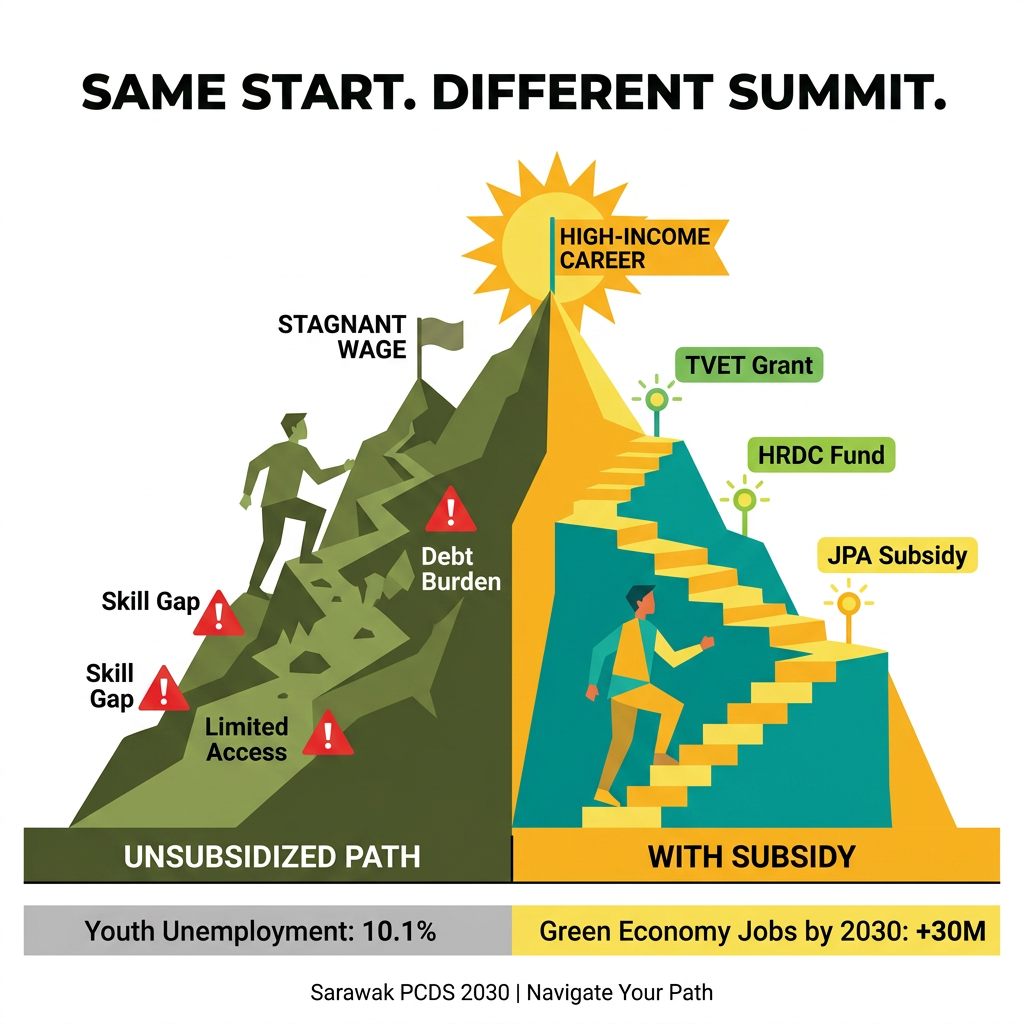
According to the Department of Statistics Malaysia, the national unemployment rate dropped to a 10-year low of 3.0% in 2025, though youth unemployment among those aged 15 to 24 remains a structural challenge at approximately 10.1%.
In Sarawak specifically, the state government has set an aggressive target to reduce its overall unemployment rate by 1.2 percentage points in 2025, heavily relying on technical and vocational training to achieve this milestone.
This aligns with the Sarawak Post-COVID 19 Development Strategy (PCDS) 2030, which puts human capital development at its core to transition the state’s workforce into the digital era.
The primary sectors driving this demand are concentrated in advanced manufacturing, green technology, and digital services.
The Asian Development Bank (ADB) projected that a shift to a green economy in Southeast Asia could create 30 million new jobs by 2030, necessitating a massive reskilling of the current labour pool.
However, the OECD Skills Outlook 2025 highlights that family background remains a strong driver of skills differences, meaning that without targeted public subsidies, mid-career workers and students from lower-income backgrounds may be left behind in this technical transition.
Therefore, understanding how to navigate these financial mechanisms is a critical step in securing long-term economic mobility.
Employer-Centric Pathway: Accessing Training and Stipends through PERKESO’s Daya Kerjaya
For mid-career individuals and graduating students, one of the most direct pathways to subsidized training is through the Social Security Organisation’s (PERKESO) Daya Kerjaya programme.
This mechanism is fundamentally employer-centric, functioning as an incentive for businesses to hire and retrain individuals for positions within high-demand technical sectors.
The financial impact of this pathway is substantial, as PERKESO reported a surge to 32,887 successful placements in 2025, up significantly from 23,638 in 2024.
Under initiatives like Daya Kerjaya 2.0, the programme provides a hiring incentive of RM1,500 a month for up to six months to encourage the employment of vulnerable groups, including recent graduates and retrenched mid-career workers.
The first step in this pathway is for the employer to initiate the process by submitting an application for the hiring incentive via the PenjanaKerjaya portal.
Once an eligible candidate is hired, the employee becomes entitled to a range of benefits designed to support their transition into a technical role.
This structured approach is highly effective; for instance, TVET graduates in Sarawak already record a 96% employability rate, proving the value of this type of industry-focused, subsidized training.
This pathway represents a powerful symbiotic relationship that aligns with international best practices, as the ADB actively advocates for the expansion of employer-led lifelong learning credits for mid-career workers to support continuous skills development.
For the jobseeker, this means securing a paid, structured training position in a desired technical field without upfront personal expenditure, effectively de-risking the career transition process.
Individual-Centric Pathway: Securing Training Grants via HRD Corp and TPPK
An alternative and complementary pathway is the individual-centric model facilitated by the Human Resources Development Corporation (HRD Corp), backed by the National Skills Development Fund (TPPK).
This route empowers applicants to proactively seek out and fund their own training.
The scale of this financial backing is massive, with HRD Corp approving RM2.62 billion in financial assistance for skills training in 2025 alone to accelerate Malaysia’s talent drive.
Furthermore, the total number of training places reached over 2.8 million in 2025, marking a significant increase in national skills development capacity.
The first step for an individual is to identify a suitable training programme via the HRD Corp e-LATiH portal.
Applicants can leverage schemes like the Subsidised Training Scheme for Individuals (SBL-KHAS), which subsidises course fees up to RM4,000.
This individual empowerment is crucial for addressing the needs of specific demographics, such as the young adults aged 25 to 39 who have recently made up the majority of those experiencing job losses in structural transitions.
The quality of these individual-centric training programmes is increasingly aligned with global standards, as the ADB emphasizes that preparing workers with the right capabilities for Industry 4.0 is central to its regional portfolio.
Additionally, the OECD notes that micro-credentials translate modularity into practice for targeted upskilling and reskilling, allowing individuals to use these HRD Corp grants to stack specific, high-demand technical skills rather than committing to multi-year degrees.
Credentialing and Quality Assurance: Leveraging MQA’s Framework for Micro-Credentials
While PERKESO and HRD Corp provide the financial scaffolding, the Malaysian Qualifications Agency (MQA) provides the crucial layer of quality assurance.
In Malaysia, micro-credentials have been formally introduced as modular, digital certifications that complement formal qualifications and provide verifiable proof of specific competencies.
For a mid-career individual or a graduating student, obtaining an MQA-aligned micro-credential is paramount for translating short-term training into tangible career progression.
The procedural pathway involves enrolling in a micro-credential programme offered by an institution adhering to MQA guidelines.
These short, focused courses are designed to be highly responsive to rapid industry evolution.
This modularity is heavily supported by regional development strategies; for example, Sarawak’s PCDS 2030 puts human capital development at its core, promoting policies that focus heavily on job-ready, modular courses.
The value of these credentials is further amplified by the need for robust digital verification.
The ADB highlights the importance of investing in high-quality digital infrastructure to support the electronic issuance and verification of credentials across borders and industries.
Furthermore, the OECD Skills Outlook 2025 emphasizes that because family background and initial educational attainment often dictate initial skills levels, portable and stackable micro-credentials are vital for creating a more equitable labour market where adults can continuously prove their newly acquired competencies.
Integrated Transition Journey: Synthesizing Pathways for Mid-Career and Student Job Seekers
The true power of Malaysia’s public subsidy ecosystem lies in the integration of PERKESO, HRD Corp, and MQA.
For a mid-career individual or a graduating student, these mechanisms can be woven together to create a multi-stage, reinforced journey.
This integrated pathway is essential for addressing the structural unemployment of youth, as Malaysia’s youth unemployment rate for ages 15-24 remains steady at around 10.1% despite overall economic improvements.
Stage 1: Foundational Upskilling.
An individual begins by addressing skill gaps using the HRD Corp e-LATiH portal.
They select a foundational course in a high-demand area like data analytics, funded by an SBL-KHAS grant.
Because the OECD benchmarks skilled workforce ratios at 50–70%, Malaysia is aggressively targeting this metric by ensuring these subsidized courses are highly relevant and rigorous.
Stage 2: Targeted Reskilling and Placement.
Armed with a new credential, the individual leverages the MYFutureJobs portal.
An employer in a growing sector, such as Sarawak’s expanding digital economy, hires them under the Daya Kerjaya programme.
The employer receives the RM1,500 monthly incentive, while the employee undergoes specialized on-the-job training.
This directly supports Sarawak’s goal to reduce its unemployment rate by 1.2 percentage points in 2025 by moving jobseekers directly into high-value roles.
Stage 3: Formal Recognition.
Upon completion, the individual holds a portfolio of MQA-accredited micro-credentials and hands-on experience.
This integrated journey demonstrates how the distinct functions of each agency are synergistic.
The ADB projects that the shift to new economies will create millions of jobs, but only if workers are systematically reskilled through these exact types of integrated, subsidized pathways.
Together, they create a robust support system that guides a job seeker from initial upskilling to secured employment in a thriving technical career.
Navigational Guide: Key Portals, Contacts, and Practical Considerations
Successfully navigating these procedural pathways requires familiarity with the key digital platforms.
The ecosystem is predominantly digital, making digital literacy a prerequisite for accessing public subsidies.
This is particularly important for mid-career individuals, as DOSM reports that young adults aged 25 to 39 made up the majority of those who lost their jobs in recent economic shifts, meaning many navigating these portals are doing so out of urgent necessity.
Beyond accessing these portals, applicants must be mindful of administrative intricacies, such as the 14-day lead time required for HRD Corp grant applications.
The complexity of navigating these systems can be daunting, but the push for digital inclusion is strong.
The ADB stands ready to support developing member countries by investing in high-quality digital infrastructure to reduce friction and make these lifelong learning opportunities more accessible to all.
Finally, it is imperative to recognize that this entire ecosystem is dynamic.
The OECD Skills Outlook 2025 emphasizes the necessity of building 21st-century skills for all, requiring continuous adaptation of these digital portals to ensure they remain accessible to adult learners from diverse backgrounds.
Applicants should always refer to the most current information available on the official agency websites, ensuring they do not miss out on the billions of ringgit allocated annually to secure their technical future.
References
Asian Development Bank. (2024). Advancing the green economy transition in ASEAN. https://www.adb.org/sites/default/files/publication/1129316/green-economy-transition-asean.pdf
Asian Development Bank. (2023). Digital jobs and digital skills: A shifting landscape in Asia and the Pacific. https://www.adb.org/sites/default/files/publication/829711/digital-jobs-digital-skills.pdf
Department of Statistics Malaysia. (2025). Labour market review, first quarter 2025. https://storage.dosm.gov.my/analysis/lmr_2025-q1_en.pdf
Department of Statistics Malaysia. (2026). Labour force survey report, first quarter 2026. https://www.dosm.gov.my/portal-main/release-content/labour-force-survey-report-first-q12026
Human Resource Development Corporation. (2026). HRD Corp approved RM2.62 billion in financial assistance in 2025, delivering skills outcomes at national scale. https://hrdcorp.gov.my/hrd-corp-approved-rm2-62-billion-in-financial-assistance-in-2025-delivering-skills-outcomes-at-national-scale
Malaysian Qualifications Agency. (2020). Guidelines to good practices: Micro-credentials. https://www2.mqa.gov.my/QAD/garispanduan/Guideline%20on%20Micro-credential%2010%20Mei.pdf
Organisation for Economic Co-operation and Development. (2025). OECD Skills Outlook 2025: Building the skills of the 21st century for all. OECD Publishing. https://www.oecd.org/en/publications/2025/12/oecd-skills-outlook-2025_ac37c7d4.html
Sarawak Government. (2021). Post COVID-19 development strategy 2030. https://sarawak.gov.my/media/attachments/PCDS_Compressed_22_July_2021.pdf
Social Security Organisation. (2025). Daya Kerjaya 3.0 programme guidelines. https://www.perkeso.gov.my/images/belanjawan2025/dayakerjaya3.0/FAQ_Daya%20Kerjaya%203.0%20EN_v2.pdf
The Borneo Post. (2025, August 26). Sarawak eyes reducing unemployment rate by 1.2 percentage points in 2025. https://www.theborneopost.com/2025/08/26/sarawak-eyes-reducing-unemployment-rate-by-1-2-percentage-points-in-2025/
We Love Sarawak. (2024, October 25). TVET in Sarawak: Shaping futures, powering growth in Borneo. https://welovesarawak.com/tvet-in-sarawak-shaping-futures-powering-growth-in-borneo/