
Historically, development communication has been treated like a transmission exercise. Planners draft a brilliant blueprint, broadcast what it means, measure how many people clicked “read,” and then pat themselves on the back, assuming understanding has taken root. Shocking plot twist: a blueprint meant to shape the next decade of daily life cannot be delivered like a software update or a public service announcement.
It needs to be a living conversation. Yet, a noticeable generational divide has emerged. Many younger Sarawakians view this strategy as a distant, dusty government document rather than a malleable roadmap they can question, challenge, and reshape to fit their actual lives.
Policy Alignment: The “Suit-and-Tie” Messenger Problem
On paper, we are totally on board with the whole “youth empowerment” thing. At the federal level, the Malaysia MADANI framework, the Twelfth Malaysia Plan, and the Malaysia Digital Economy Blueprint all explicitly call for participatory governance. Sarawak’s own Digital Economy Strategy and Post-COVID Development Strategy 2030 echo these exact ambitions, focusing on digital infrastructure and human capital.
But here is where the policy intent gets hilariously lost in translation. When the faces and voices delivering these narratives are predominantly senior officials in suits, the message lands as a lecture rather than an invitation. Because nothing resonates with a 20-something content creator quite like a 45-minute PowerPoint on economic diversification, right?
To fix this, the policies need champions who actually look and sound like the target audience. We need young entrepreneurs, students, and grassroots innovators to translate lofty policy pillars into the language of digital livelihoods, housing aspirations, and cultural pride.
Data Spotlight: The “They Aren’t Online” Myth
Let’s address the elephant in the room: the quiet, damaging assumption that rural kids in longhouses and small towns are living completely off the grid. Spoiler alert: they aren’t. The assumption that rural youth aren’t online is dangerously outdated.
Let’s look at the actual numbers, shall we? The data paints a very different picture when we compare the local, national, and global landscapes:
- 🇲🇾 Malaysia (National Reality): According to the MCMC, internet penetration hit a staggering 97.5% in Q3 2023. Meanwhile, the Department of Statistics Malaysia (DOSM) reports that smartphone ownership among youth is practically universal (nearly 100%).
- 🌲 Sarawak (State Progress): Thanks to the Joint Mobile Network project and new telecommunication towers under the Jalur Gemilang Network initiative, rural internet connectivity in Sarawak has leveled up massively.
- 🌍 Global & Economic Impact: The World Bank notes the digital economy is projected to pump 25.5% into Malaysia’s national GDP by 2025. Globally, UNICEF data confirms that youth in developing regions are already leveraging mobile tech for education, entrepreneurship, and civic expression.
The Takeaway? Rural youths are not passive consumers waiting to be saved. They are active content creators on TikTok and YouTube, building audiences and navigating the digital economy with remarkable agility. If our official digital strategy is limited to static web pages with a “Contact Us” form that leads to a void, we are completely missing this energetic, video-first audience. We need to go where they already are: short-form videos, interactive live sessions, and collaborative creation challenges.
Redefining Metrics: The “Vanity Metrics” Trap
We have a bad habit of confusing “reach” with “engagement.” Counting the number of people exposed to a message is broadcasting, not communicating.
Real development communication closes the loop. It captures youth reactions, doubts, and original ideas, and then visibly weaves that feedback into the plan. The UNDP literally has studies proving that participatory approaches yield significantly higher project sustainability.
When a young person in a longhouse or a cafe in Miri voices a concern about digital infrastructure, that voice must be demonstrably heard. Without visible evidence that their participation actually changes something, our communication remains a monologue, and the generational gap just keeps widening.
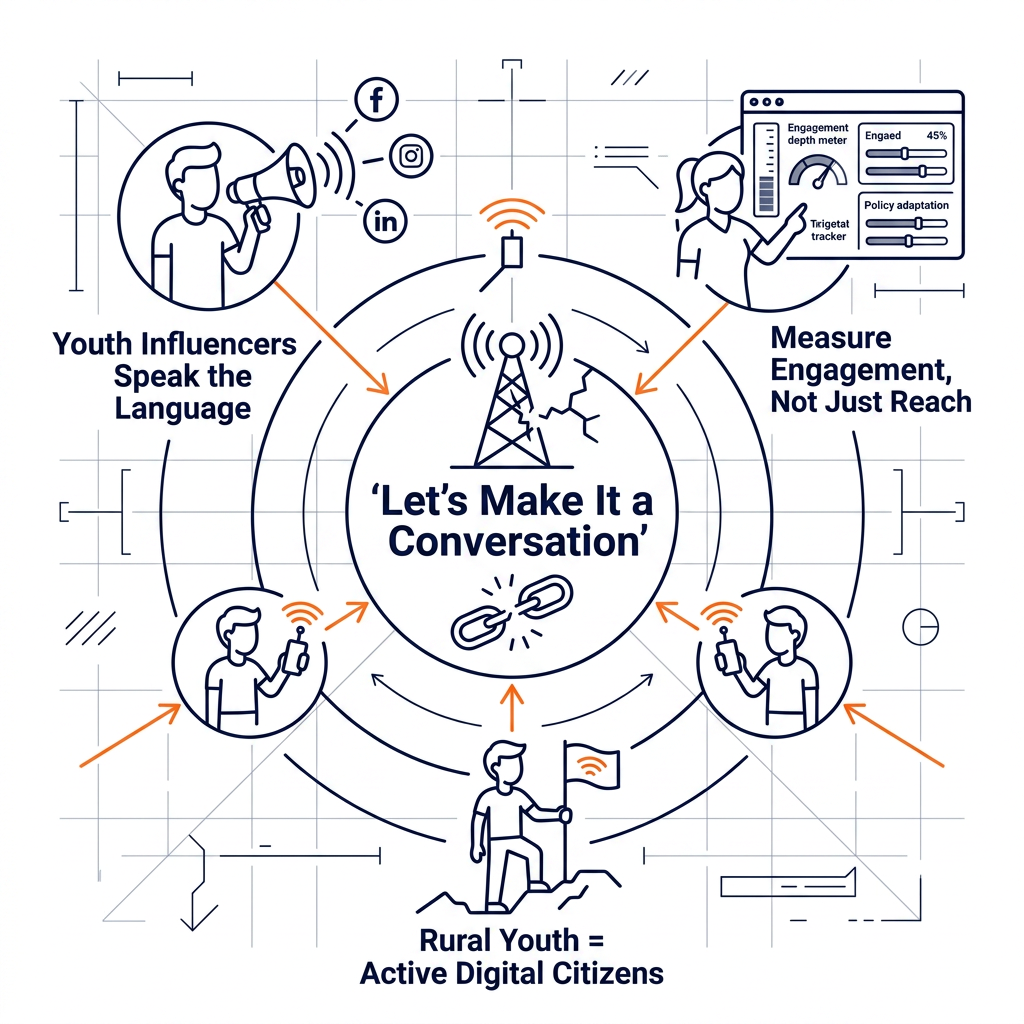
Strategic Shifts: Let’s Make It a Conversation
The core task is to stop treating development communication as the transmission of a finished, untouchable document. It must be designed as a continuous, messy, and meaningful conversation.
Here is the game plan:
- Dismantle the messenger mismatch: Empower youth influencers who understand the local vernacular and digital culture.
- Upgrade the metrics: Shift from obsessing over mere “reach” to measuring actual engagement and policy adaptation.
- Update our worldview: Recognize rural youth as active digital citizens, not disconnected beneficiaries.
The development strategy will only become a living roadmap when young people see their own fingerprints on it. This will happen not because we told them it matters, but because we actually let them help make it matter. By aligning with the participatory goals of the national MADANI agenda and the Sarawak digital economy vision, we can finally transform this top-down broadcast into a collaborative movement.
Because honestly, it’s time we started talking with the next generation, rather than just talking at them.
References
- Department of Statistics Malaysia. (2023). Current population estimates report 2023.
- Malaysian Communications and Multimedia Commission. (2023). Communications and multimedia sector report: Third quarter 2023.
- Ministry of Communications and Digital Malaysia. (2021). Malaysia digital economy blueprint.
- Prime Minister’s Department. (2023). Malaysia MADANI: A framework for sustainable development.
- United Nations Children’s Fund. (2023). State of the world’s children 2023.
- United Nations Development Programme. (2022). National human development report Malaysia 2022: Moving forward together.
- World Bank. (2023). Malaysia economic monitor: Navigating global headwinds.