
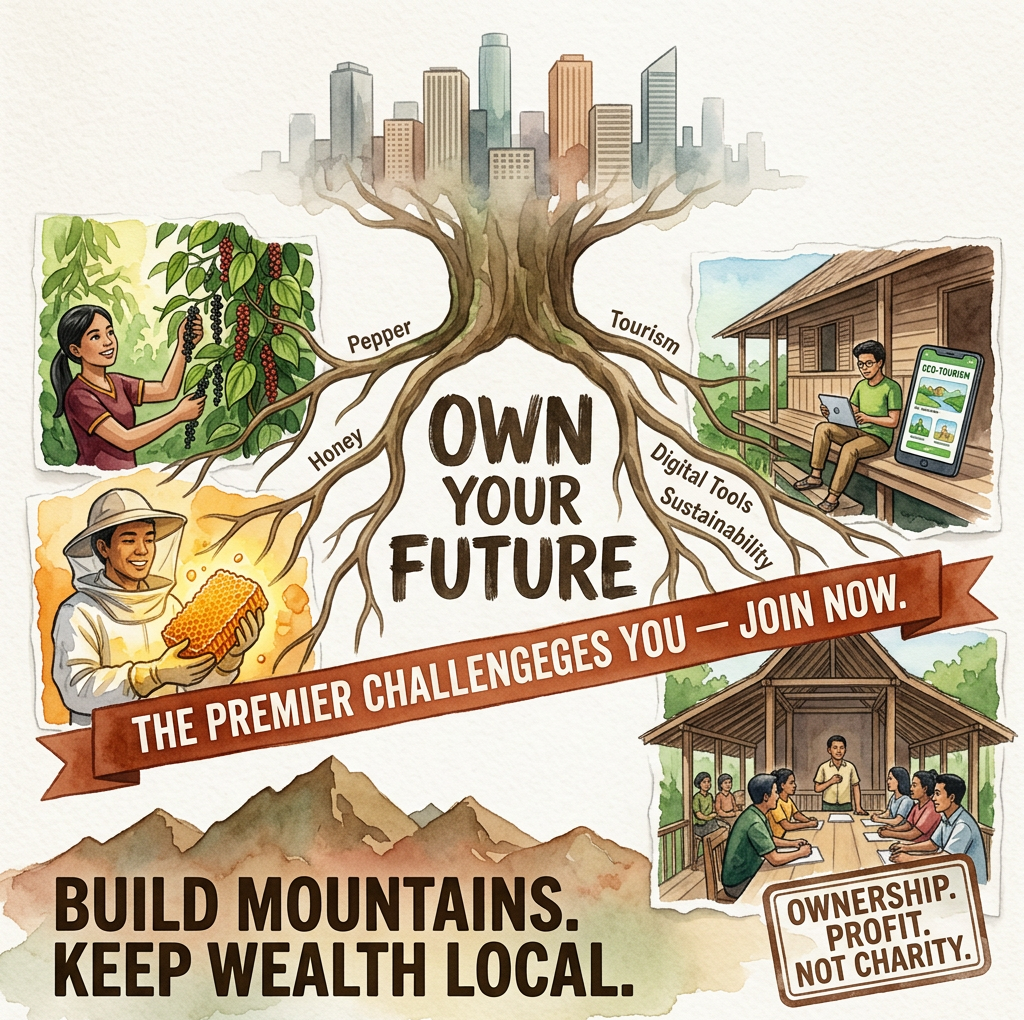
What happens when your kampung’s coconut trees and pepper vines no longer provide a living wage? For too long, rural youth have been told success requires leaving for the city. This narrative has driven a devastating exodus, leaving over half of Malaysia’s agricultural land managed by those aged 50 and above. Yet, opportunity does not require leaving; it requires reimagining. The cooperative movement is the most powerful, underutilised tool for young Sarawakians to build wealth and shape their communities’ futures. This is not charity; it is a collective business model where you own the company, make decisions, and keep profits.
From Rochdale Roots to Sarawak’s Digital Frontier Cooperatives are global economic engines. In Malaysia, 16,284 registered cooperatives hold RM173.3 billion in assets. Sarawak alone has 1,190 cooperatives generating nearly RM369 million. However, youth remain dramatically underrepresented. Nationally, fewer than one in 100 young Malaysians is a cooperative member. Leaders like SKM Chairman Datuk Ahmad Norihan Jalal warn of a significant succession gap.
But the modern cooperative is not a dusty sundry shop. It is a tech-enabled, sustainability-driven enterprise. The revenue of youth cooperatives in Malaysia has surged fourfold in five years, rising from RM3.5 million to RM14.3 million. This sleeping giant is wide awake and looking for you.
Building Wealth Without Betraying the Land Young Sarawakians inherited Borneo’s natural wealth and the responsibility to preserve it. The cooperative model builds prosperity aligned with the UN Sustainable Development Goals (SDGs) and ESG principles. Cooperatives advance SDG 8 by creating stable jobs and empowering youth.
In Sarawak, this aligns with the Sarawak Sustainability Blueprint 2030. Imagine a youth cooperative harvesting wild honey, securing organic certification, and marketing directly to global consumers. This is ESG in action: environmental sustainability, social impact, and democratic governance. Inspiring models like the Dakata Youth Cooperative in Sabah show how young people integrate fish farming, agriculture, and homestays into diversified, resilient businesses.
Why Are Young People Not Joining? If the model is so powerful, why the low participation? First, an image crisis: youth associate cooperatives with outdated, bureaucratic structures, preferring tech and creative startups. Second, economic pressures push youth toward individual corporate careers. Third, an awareness gap exists, especially in rural Sarawak, where modern cooperative potential remains unseen. Furthermore, government outreach often struggles to penetrate the digital spaces where young people spend their time, leaving a glaring accessibility gap. Finally, the fear of navigating registration and governance deters potential founders. These are solvable communication and education challenges.
What the Premier Sees in You Premier Datuk Patinggi Tan Sri (Dr) Abang Haji Abdul Rahman Zohari bin Tun Datuk Abang Haji Openg envisions Sarawak as a global leader, placing his faith in youth. He stresses that rich natural assets require human capital. “When you have productive, skilled people working with rich natural resources, the world becomes yours,” he notes. This is the cooperative logic: transforming local resources through collective youth innovation. Urging youth to embody the warrior cry Agi Idup, Agi Ngelaban, the Premier challenges them to be pioneers: “If you place Sarawakians on land, they become a mountain.” Cooperatives are the perfect platform to build that mountain.
A Campaign to Win Your Generation Bridging the participation gap requires a strategic, youth-centric campaign:
- Digital Identity: Rebrand cooperatives like tech startups. Use TikTok and Instagram for authentic, 60-second case studies created by youth.
- Ambassadors: Profile successful young rural cooperative leaders. Host informal “Kopi Koperasi” meet-ups and digital peer networks.
- Education: Expand programmes like Graduate to Cooperative. Introduce cooperative incubation at universities like UNIMAS and Swinburne.
- Start-up Kits: Simplify registration with an online portal, video tutorials, and a dedicated youth hotline.
- Competitions: Launch a Sarawak Youth Cooperative Challenge with pitch competitions, cash grants, and mentorship.
- Integration: Embed cooperative modules into existing platforms like Rakan Muda to reach millions efficiently.
Your Cooperative, Your Sector, Your Future Cooperatives can apply to any sector. Whatever your passion, there is a cooperative pathway to ensure resources benefit the local community rather than being extracted for outside profit. In agriculture, co-ops can aggregate pepper or invest in modern fertigation for export. In the digital economy, youth can form agencies for web development or rural e-commerce platforms. For eco-tourism, community co-ops can manage homestays and guided tours. In green energy, co-ops can develop micro-hydro projects. For heritage, artisans can market pua kumbu textiles globally. The common thread is ownership, collective action, and keeping wealth in Sarawak.
This Generation, This Decision Rural communities are aging, and talent is leaving. The Premier has called upon you to build the mountain. The infrastructure and policies are in place. What is missing is you. This is an invitation to be a founder and owner in your community. The cooperative movement does not need you to be a follower. It needs you to be the creators of something the world has never seen. The land and resources are here. What will you and your friends build together?
References Food and Agriculture Organization of the United Nations. (2022). Youth in agrifood systems: A review of the evidence and policy implications. https://www.fao.org/3/cc2153en/cc2153en.pdf
International Co-operative Alliance. (2023). World cooperative monitor 2023: Estimating the impact of cooperatives and the cooperative advantage. https://www.ica.coop/en/world-cooperative-monitor
International Labour Organization. (2022). Cooperatives and the social solidarity economy: Promoting decent work and sustainable development. https://www.ilo.org/global/topics/cooperatives/lang–en/index.htm
Kementerian Belia dan Sukan Malaysia. (2023). Program Rakan Muda. https://rakanmuda.kbs.gov.my/
Kerajaan Negeri Sarawak. (2021). Post-COVID-19 Development Strategy 2030 (PCDS 2030). https://pcds2030.sarawak.gov.my/
Suruhanjaya Koperasi Malaysia. (2023). Statistik koperasi Malaysia. https://www.skm.gov.my/index.php/en/statistik
World Bank. (2023). Sarawak rural infrastructure development project (Project P171235). https://projects.worldbank.org/en/projects-operations/project-detail/P171235